


She's Run a Yoga Empire Since 1997 — Here's Her Day

Inside the Daily Routine of a Yoga Luminary Who Has Taught 100,000 Sessions
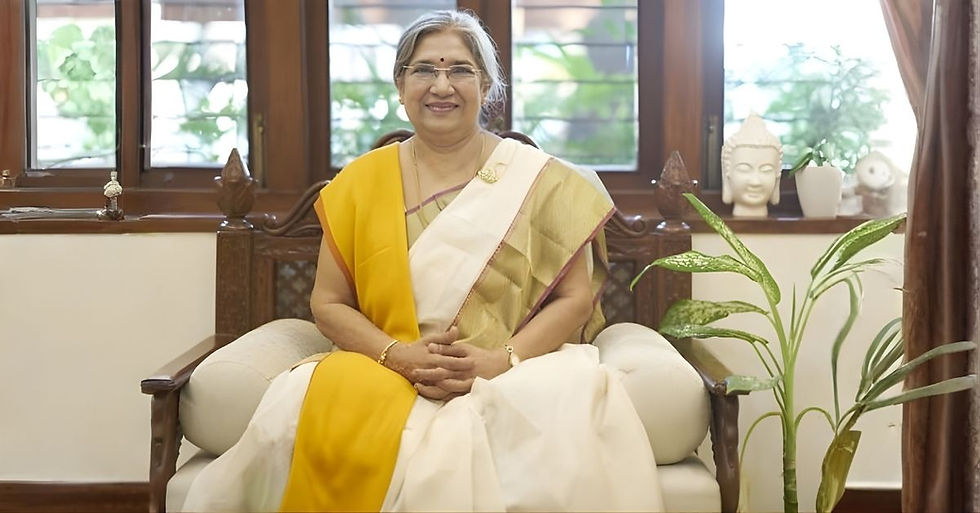
Dr. Hansaji Yogendra serves as the Director of the Yoga Institute and as the President of the Indian Yoga Association. Over the decades, she has played a defining role in strengthening the Householder’s Yoga Movement, championing the idea that the wisdom of classical yoga should be accessible not only to renunciates, but also to individuals living active family and professional lives.
Her work is rooted in a lifelong commitment to public service, holistic well-being, and the personal development of ordinary people. With remarkable clarity and compassion, she has dedicated herself to interpreting and presenting the principles of traditional yoga in a practical, relatable, and beneficial way for contemporary society. Making authentic yogic knowledge understandable and applicable for the wider public has remained central to her mission.
Under her stewardship, The Yoga Institute has earned national recognition, including the Prime Minister’s Award for Outstanding Contribution to the field of Yoga, conferred by Narendra Modi.
Dr. Hansaji Yogendra is widely respected not only as a yoga authority and educator but also as a philanthropic leader whose work reflects a broader vision of social harmony, ethical living, and collective well-being. Her efforts continue to inspire individuals and institutions alike to embrace yoga as a pathway toward balanced, meaningful, and responsible living.
Dr. Hansaji Yogendra, in a yellow and white saree, seated in a wooden chair with Buddha statue femina
What if your entire day — from the first breath to the last thought before sleep — was a form of practice? Not performance. Not productivity hacking. Pure, intentional practice.
Most people chase wellness on weekends and abandon it by Tuesday. But there exists a rare category of human beings whose entire life is a living curriculum. This blog post decodes the deeply inspiring, never-before-documented daily rhythm of one such luminary — the Director of the world's oldest organised yoga centre — whose morning, afternoon, and evening are blueprints for a life most of us only dream about.
Her daily routine is not about extremes. It is not about a 5 AM cold plunge or a $200 green smoothie. It is about something far more radical: living in alignment with nature, breath, and purpose — every single hour.
The iconic presence of The Yoga Institute's Director — decades of discipline distilled into every gesture.
Why Your Routine Reveals Your Reality
Before decoding the blueprint, understand this: a routine is not a schedule. A schedule is what you plan. A routine is what you become.
Science consistently confirms what ancient yoga philosophy has long held — that habitual daily rhythms fundamentally reshape your biology. Circadian science at Harvard Medical School shows that consistent wake-sleep cycles regulate cortisol, insulin, and neurotransmitter production. Ayurveda calls this disciplined daily cycle Dincharya — a concept that aligns every hour of your day with the body's shifting energy tides.
The yoga luminary we study in this piece has spent decades not just teaching this wisdom but living it publicly, quietly, and without compromise. Her 24-hour blueprint has been refined over five decades of practice, research, teaching, and service. Yogaiya
"Yoga is not something you do for an hour. It is something you become over a lifetime."— A core principle of The Yoga Institute's philosophy
4:30 AM — When the World Sleeps, She Awakens
Silhouette of a woman in warrior yoga pose on a seaside rock at sunrise
The day begins before dawn — not with an alarm clock's jarring interruption, but with the body's own trained internal clock. Waking between 4:30–5:00 AM aligns with what Ayurveda calls Brahma Muhurta, the sacred window roughly 90 minutes before sunrise. During this period, the vata dosha (air + space energy) is dominant — a natural state that supports mental clarity, spiritual contemplation, and creative thinking.

The first act upon waking? No phone. No news. No noise.yogapedia
Instead, she begins with Sahaj Asana — natural, gentle movements performed while still lying down. The logic is profound: the body has been static for hours, muscles are tight, and spinal fluid needs to be rehydrated before any vigorous movement. A few minutes of conscious stretching — moving limbs, rotating shoulders, and flexing the feet — gently activates the parasympathetic nervous system.
Actionable Tip: Place your phone charger in another room. The first 10 minutes of your morning define the emotional tone of your entire day. Use them for your body, not your inbox.
Dawn practice — the most sacred hours of a yogic day begin before the sun rises.
5:00 AM — The Breath That Precedes Everything
Once the body is gently awakened, the practice of Pranayama begins. This is not casual breathing. These are structured, scientific breathing techniques — Anulom Vilom (alternate nostril breathing for neural balance), Bhramari (humming bee breath for calming the nervous system), and Abdominal Breathing (diaphragmatic breathing for oxygenation and vagal tone).

What does science say? A 2018 study published in the Journal of Neurological Sciences confirmed that slow, controlled breathing activates the vagus nerve — the body's master regulator of the stress response — reducing blood pressure, heart rate, and cortisol within minutes. The Yoga Institute has conducted over 1,00,000 theoretical and practical sessions documenting precisely these effects.
The morning pranayama session typically lasts 20–30 minutes and follows a specific sequence:
Abdominal breathing (5 minutes) — Grounds awareness in the body
Anulom Vilom (10 minutes) — Balances left (ida) and right (pingala) energy channels
Bhramari (5 minutes) — Reduces mental noise and anxiety
Silence (5 minutes) — Pure meditative absorption
"Don't fear effort. Fear a life that's too easy."— Dr. Hansaji Yogendra, The Yoga Institute
5:30 AM — Asanas: Not Gymnastics, But Medicine
A large group in colorful attire is practicing yoga and seated meditation in the auditorium
The asana practice that follows is classical — not the Instagram-worthy contortions that dominate modern social media. These are Hatha Yoga asanas from the lineage of The Yoga Institute, founded in 1918, and the world's oldest organised yoga centre.
Key asanas in the morning sequence include:
Yogendra Tadasana — Improves posture and awakens spinal alignment
Yogendra Bhujangasana — Strengthens the back and stimulates the adrenal glands
Yogendra Paschimottanasana — Activates the parasympathetic system and stimulates digestion
Yogendra Utkatasana — Awakens the legs, thighs, and metabolism
Yogendra Konasana — Improves spinal health and lateral flexibility
This sequence takes approximately 30–40 minutes. Crucially, each pose is held with conscious awareness — not rushed through for fitness points, but used as a meditation in motion.
Classical yoga practice at The Yoga Institute — hundreds of students learning the asanas in their original, therapeutic form.
6:30 AM — Prayer, Gratitude, and the Architecture of a Conscious Mind
After asana and pranayama, the practice moves inward. A short period of prayer and meditation begins the process of setting intention for the day. This is not religious in the sectarian sense — it is philosophical. It is the act of consciously choosing your mental posture before the world imposes one on you.
This practice reflects one of the three personal mantras she has publicly shared:
Self-love — Treating the body and mind as sacred instruments, not machines
Celebrating small wins — Training the mind to find genuine joy in incremental progress
Not depending on others for happiness — Cultivating an internal locus of contentment
These are not motivational slogans. They are cognitive architectures — habits of mind that, practiced daily, rewire the brain's default mode network toward resilience and equanimity.
Actionable Tip: Write down three things you are genuinely grateful for before you open any app. This single habit shifts prefrontal cortex activity within 30 days (source: Emmons & McCullough, Journal of Personality and Social Psychology, 2003).
7:00 AM — The Yogic Breakfast: Food as Vibration
Sattvic Indian vegetarian thali with vegetable curries, rice, yogurt on banana leaf theannapurnaexpress

The sattvic diet philosophy does not treat food as fuel. It treats food as information — signals sent to the body's cellular intelligence. The morning meal follows strict principles rooted in Ayurveda and decades of research.
A typical yogic breakfast includes:
Soaked nuts (almonds, walnuts) — Rich in protein, omega-3, and healthy fats; consumed around sunrise hindustantimes
Seeds (flaxseed, chia, pumpkin seeds) — Flaxseed alone rivals the omega-3 content of eggs
Fruits — Seasonal, preferably local; consumed separately to avoid fermentation in the gut
Warm water with lemon — Stimulates the liver and kickstarts digestive enzyme productiontheannapurna
The guiding principle: eat light in the morning, heavier at noon, lighter again at night — mirroring the body's digestive fire (agni), which peaks at solar noon and wanes by evening.
The sattvic thali — each ingredient chosen for its vibrational quality, digestibility, and nourishing effect on the mind.
8:00 AM–12:00 PM — The Luminary at Work: Leading the World's Oldest Yoga Centre
By 8 AM, the public work begins. As Director of The Yoga Institute — Mumbai, the world's oldest organised yoga centre established on December 25, 1918, the morning hours are spent teaching, counseling, providing administrative leadership, and creating content.
The institute runs under her stewardship with programs including:
21-Day Better Living Courses — Immersive programs in classical yoga philosophy and practice
900-Hour Teacher Training Courses — Producing certified yoga teachers for the global community
Yoga OPD (Samattvam) — Free healthcare through yoga for those with chronic conditions
Nispand Meditation App — A digital extension of The Yoga Institute's healing traditions
Her leadership earned the institution the Prime Minister's Award for Outstanding Contribution to the Field of Yoga — India's highest recognition in this domain.
What separates great leaders from good ones? She does not merely administer. She demonstrates. Every program she leads is one she herself has lived. Her authority is not positional — it is embodied.
12:00 PM — The Noon Meal and the Art of Conscious Eating
Thali with roti, dal, sabzi, raita, and lassi on a plate
The Yoga Institute's philosophy insists: the biggest meal belongs at noon, when digestive fire is strongest. This aligns with modern chronobiology research showing that the body's digestive enzymes, insulin sensitivity, and gut motility peak between 11 AM and 2 PM (Sutton et al., 2018, Cell Metabolism).

A typical noon meal:
Dal with rice (provides a complete amino acid profile)
Roti with sabzi (fibre, micronutrients, and slow-burning carbohydrates)
Salad (raw fibre for gut microbiome diversity)
Glass of buttermilk (probiotics, calcium, cooling effect on pitta)jindalnature
After lunch: 100 slow steps — a post-meal walking ritual that dramatically improves gastric motility and blood sugar regulation.
A yogic lunch — seasonal vegetables, dal, roti, and fermented dairy consumed mindfully at noon for optimal digestion.
2:00 PM–6:00 PM — Conscious Work, Conscious Rest
The afternoon corresponds to what Ayurveda calls the W (waning) phase — a natural drop in cognitive sharpness that the body signals through mild lethargy after 2 PM. Rather than fighting this rhythm with coffee, the yogic approach embraces it.
Practices during this window:
Shavasana or Yoga Nidra (10–15 minutes) — A conscious rest technique that provides 4 times the restorative benefit of equivalent sleep (source: Sleep Research Society)
Light administrative tasks — Reading, correspondence, content review; nothing demanding deep analytical focus
Short walking breaks — Every 90 minutes, a 5-minute walk resets the cortisol cycle and improves afternoon cognitive performance
This is the phase where most modern professionals crash — reaching for stimulants or scrolling endlessly. The yogic alternative is radical acceptance: rest when the body asks for it, and emerge sharper.
6:00 PM — Evening Practice: Closing the Day's Energetic Loop
As the sun begins to set, the evening practice begins — a gentle counterpart to the morning's more vigorous session. This typically includes:
Joint-opening stretches — releasing the physical tension accumulated through the dayYouTube
Anulom Vilom — resetting the nervous system for transition from work to rest
Trataka (candle gazing) — a yogic practice for improving concentration and relieving eye strain from screens
Journaling or reflective contemplation — reviewing the day without judgment
The evening session is shorter — 20 to 30 minutes — but its psychological value is immense. It signals to the nervous system: the active phase is complete. It is now time to restore.
7:00 PM — The Dinner That Serves Sleep
Dinner is consumed by 7 PM — a non-negotiable in this lifestyle. The logic is physiological: the liver begins its detoxification cycle around 10 PM. For this process to proceed optimally, the stomach must be substantially cleared of its last meal.
The yogic dinner formula:
Large bowl of mixed vegetable soup (light, hydrating, easily digestible)
Optional: a small portion of rice or roti pieces added to the soup
No heavy proteins, no raw salads, no desserts after 7 PM
This pattern consistently shows up in longevity research. The CALERIE study (Duke University, 2022) confirmed that time-restricted eating with an early dinner cutoff improves metabolic markers, reduces inflammation, and extends healthy lifespan.
8:00 PM — Family, Service, and the Practice of Being Present
One of the most striking aspects of this daily rhythm is how deliberately time is carved out for family and human connection. In a world where productivity culture celebrates busyness as virtue, this is quietly subversive.
The evening hours involve:
Reading — both personal development and light literature
Family conversations — genuine, screen-free engagement
Head and foot massage — an Ayurvedic ritual (Abhyanga) that calms the nervous system, improves lymphatic circulation, and prepares the body for deep sleep
This is the often-missing piece in wellness conversations. You can optimize your sleep with every supplement on the market, but the most effective sleep preparation is human warmth, touch, and the nervous system's transition from doing to being.
10:00 PM — Sleep as the Supreme Practice
Lush garden gazebo with central pool at The Yoga Institute, Mumbai Santacruz theyogainstitute
Lights out between 10:00–10:30 PM. This aligns precisely with what Ayurveda calls the P (pitta) phase of the night — the window when the body's repair and detoxification processes are most active.

The pre-sleep protocol:
Wear loose, comfortable cotton clothing
Dim all artificial lights 30 minutes before bed
Brief head massage
No screens for the final 60 minutestheyogainsti
Modern neuroscience fully corroborates this. Matthew Walker's research (Why We Sleep, 2017) confirms that artificial blue light suppresses melatonin secretion for up to 3 hours, fragmenting the sleep architecture that the body needs for cellular repair, memory consolidation, and immune function.
The result? 7–8 hours of restorative sleep — not as a luxury, but as the foundation upon which every other practice in this blueprint depends.
The tranquil campus of The Yoga Institute, Mumbai — a 100-year-old sanctuary where this way of life has been practiced, taught, and transmitted across generations.
The Three Principles Underlying the Entire Blueprint
Strip away the specific practices and a clear philosophical architecture emerges. This daily routine is built on three foundational pillars:
1. Alignment Over Optimization
Modern wellness culture is obsessed with optimization — sleep scores, HRV numbers, macro ratios. This blueprint prioritizes alignment — the body living in harmony with natural rhythms rather than being forced into artificial efficiency
2. Consistency Over Intensity
Five decades of practice at a moderate, sustainable intensity produces what no 30-day challenge can: structural transformation. The nervous system, gut microbiome, hormonal axis, and brain's default mode network are all profoundly shaped by what you do every single day — not what you do occasionally with great effort.yogaiya
3. Integration Over Compartmentalization
Yoga is not the 45-minute session before work. In this blueprint, everything is practice — eating, breathing, working, resting, connecting. This is what the Householders Yoga Movement, which she has led for decades, fundamentally means: yoga not as retreat from life, but as the very texture of life.
What Science Says About This Blueprint
Practice | Modern Research Validation | Benefit |
Pre-dawn waking (Brahma Muhurta) | Circadian biology (Harvard, 2021) | Cortisol regulation, mental clarity |
Pranayama | Vagal nerve stimulation studies | Stress reduction, cardiac coherence |
Sattvic diet + early dinner | CALERIE study (Duke, 2022) | Metabolic health, longevity |
Post-lunch walk (100 steps) | BMJ study, 2022 | Blood sugar regulation, gut motility |
Yoga Nidra | Sleep Research Society | 4x restorative efficiency of sleep |
Head massage (Abhyanga) | Ayurvedic clinical trials | Cortisol reduction, sleep quality |
10 PM sleep | Walker (2017), Nature Reviews | Optimal repair and detox cycles |
How to Begin: Your 7-Day Starter Blueprint
You do not need to overhaul your entire life tonight. Begin with one anchor habit and build from there.
Day 1–2: Set your alarm 30 minutes earlier. Lie in bed and breathe consciously for 5 minutes before standing up.
Day 3–4: Add 10 minutes of gentle joint movements before leaving the bedroom.
Day 5–6: Move dinner to 7 PM and replace your phone with a book for the last hour before sleep.
Day 7: Experience — genuinely, physically experience — the difference. Then decide how much further you want to go.
The yogic daily routine is not a destination. It is a direction.
Start pointing yourself there.
A Story Worth Remembering
A woman in her mid-30s from a small town in Maharashtra had been living with chronic fatigue, persistent back pain, and anxiety for nearly seven years. She had tried everything — physiotherapy, supplements, multiple doctors. Nothing held.
A neighbour introduced her to The Yoga Institute's free online sessions. She began waking at 5 AM, not because a guru commanded it, but because she noticed — within two weeks — that the morning hours gave her something no afternoon productivity hack had: silence that belonged entirely to her.
Six months in, her back pain had diminished by half. Her anxiety had not disappeared, but she had learned to observe it rather than be consumed by it. Her doctor noted a meaningful drop in her blood pressure.
The transformation was not dramatic. It was quiet, cumulative, and irreversible.
The lesson? The most powerful health intervention available to most people costs nothing. It asks only for time, consistency, and the willingness to listen to one's own body — before the world gets a chance to speak first.
The Blueprint Is Yours to Claim
The daily rhythm described in this post is not the exclusive property of a yoga director with five decades of training. It is a universal human architecture — designed by evolution, validated by science, refined by tradition.
Every pre-dawn breath you take in silence is an act of reclamation. Every meal eaten mindfully and early is a vote for your future self. Every evening you choose family over screens, and rest over one more hour of output, is a profound act of self-love in a world that profits from your depletion.
The world's oldest yoga centre did not survive 100 years because yoga is a trend. It survived because the practices it protects are in alignment with what human beings most deeply need: rhythm, breath, nourishment, connection, and stillness. Theyogainstitute
Begin today. Not perfectly. Just begin.
💡 DID YOU KNOW?
The Yoga Institute has been running continuously since December 25, 1918 — making it the world's oldest organised yoga centre. Under the current Director's leadership, it received the Prime Minister's Award for Outstanding Contribution to the Field of Yoga. Over 100,000 theoretical and practical sessions have been conducted. The Nispand Meditation App extends this legacy into the digital world.
🔗 USEFUL LINKS:
📌 The Yoga Institute Official Website: https://theyogainstitute.org
📌 Nispand Meditation App (Play Store): https://play.google.com/store/apps/details?id=com.nispand.com
💬 JOIN THE CONVERSATION:
→ Which practice from this blueprint will you start with?
Comment below.→ Have you tried waking at Brahma Muhurta?
Tell us what happened.→ Share this video with one person who needs to reclaim their mornings.
🔔 SUBSCRIBE for weekly deep dives into classical yoga, Ayurvedic wellness, and the science of living well.
📌 SAVE this video — you will want to come back to it.
👍 LIKE if this blueprint shifted something for you.

Comments